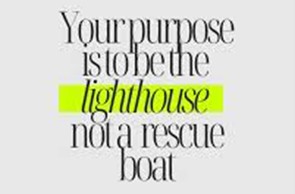
It is amazing, or I would rather say – divine, as to how the right words seem to appear when needed. I was struggling to be there for someone whom I thought God put in my life. He was an older gentleman, living alone and seemed to need someone to talk to. It became a lot more than that and the conversations turned toxic. As I was reflecting on what to do, my wife shared an Instagram post by @jayjaydouglas, on the concept to be a lighthouse and not a rescue boat. It was what I needed to hear. The more I reflected and researched the concept; the clearer things became. I needed to be a lighthouse and not a rescue boat.
The lighthouse/rescue boat analogy highlights distinct differences between empowering and enabling. A lighthouse stands firm and shines its light, it emphasizes providing guidance, allowing ships to navigate storms on their own. It doesn’t rescue, fix, or enable. A rescue boat goes out into the water to physically rescue people. It is constantly intervening, saving, or rescuing others. Being a rescue boat can lead to exhaustion and co-dependence. Rescue boats with constant engagement risk being overwhelmed and sinking themselves – extinguishing our light. While a rescue is essential in emergencies, it is not a sustainable approach long-term.
Lighthouses serve as a beacon for lost ships. A lighthouse does not chase the lost. Those who are willing to do the work will navigate based off the light and guidance provided. The Lighthouse shows the way through the storm so we can rescue ourselves, promoting independence and resilience.
It’s easy to slip into the “rescue boat” mentality because it can be gratifying. We want to help, but risk crossing the line encouraging a “Superman Complex.” The unrealistic sense of responsibility, when individuals believe they must save others to prevent failure. Rescuing causes us to leave our place and chase people who aren’t anchored, solving problems and feeling responsible for outcomes beyond our control. Often the need for rescue is from storms people choose for themselves. I did a blog back in 2017, my first year of blogging titled, You Can’t Build on Broken and being a rescue boat in many cases is struggling to build on what’s not working. I love this quote from that blog:
“The Lord works from the inside out. The world works from the outside in. The world would take people out of the slums. Christ takes the slum out of the people and then they take themselves out of the slums. The world would mold men by changing their environment. Christ changes men, who change their environment. The world shapes human behavior, but Christ can change human nature.”- Ezra Taft Benson
As a lighthouse we can teach skills and provide resources that help navigation through challenges. The light we provide is valuable and keeping it burning, as brightly as possible, is essential for everyone who relies on the guidance to find their way home. We must illuminate the way without losing our own light.
I am struggling with one part of this analogy. I am a proponent of meeting people where they are and this is what a rescue boat does. Sometimes we need to take the message to those that need it, hand delivery. No doubt that being a lighthouse and broadcasting will cover large areas or audiences in real time offering immediate engagement. However, it can be less precise and meaningful.
It’s not wrong to seek connection and we should listen deeply and find ways of relating. But we need to be careful that “connecting with” is not the same as “validating” especially in the case of unhelpful narratives. Rescuing or intervening directly should be during emergencies or crises. We should avoid the rescue boat concept with simple tasks and matters or where we are doing the work for others.
Being a light was a topic of some earlier blogs, In a World Full of Hate be a Light – Coach Mahr, Be a Light – Coach Mahr. The theme is found throughout Scripture:
- Psalm 43:3a – “Send your light and your fidelity, that they may be my guide” – Your light and your fidelity: a pair of divine attributes personified as guides for the pilgrimage.
- Psalm 18:29 – “For you, LORD, give light to my lamp; my God brightens my darkness.”
- Psalm 119:105 – “Your word is a lamp for my feet, a light for my path.” This verse symbolizes God’s truth guiding believers through darkness and storms, acting as a beacon of hope and safety.
- Proverbs 6:23 “For the command is a lamp, and the teaching a light”
- Matthew 5:14–16 – “You are the light of the world. A city set on a mountain cannot be hidden. Nor do they light a lamp and then put it under a bushel basket; it is set on a lampstand, where it gives light to all in the house. Just so, your light must shine before others, that they may see your good deeds and glorify your heavenly Father.”
- John 8:12 – Jesus spoke to them again, saying, “I am the light of the world. Whoever follows me will not walk in darkness, but will have the light of life.”
In St. Paul’s letter to the Galatians (6:5) he notes that correcting one’s own conduct avoids burdening others with it, “for each will bear his own load.”
Be a lighthouse. Let the light do the work. Let God’s love and light shine through our presence so that those who are meant to find their way, will. Be called to stand. Be called to shine.